
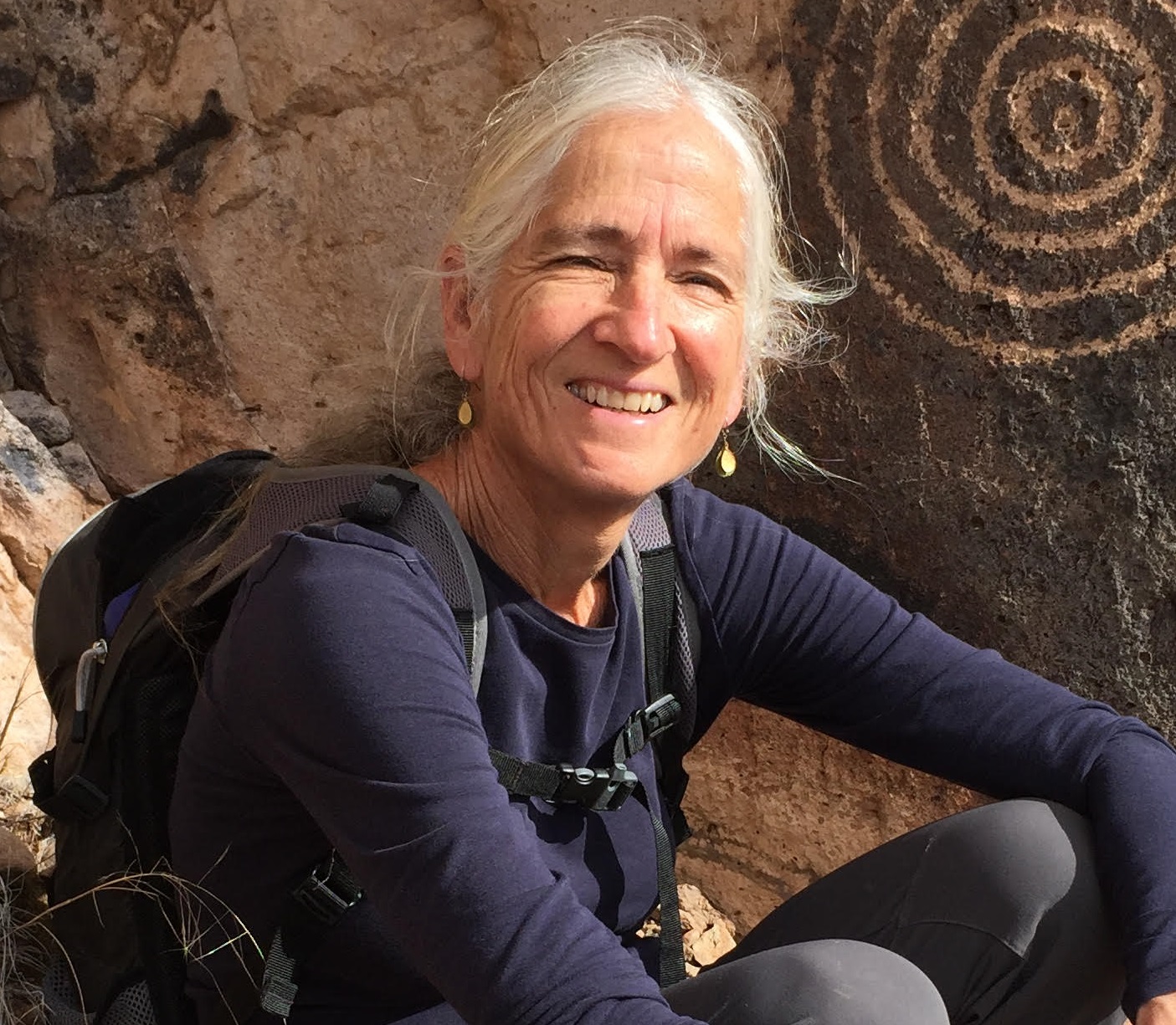
Grow Your Writing with Sharman
Sharman Apt Russell lives in the magical realism of southern New Mexico. She has been an affiliate faculty in creative nonfiction at Antioch University in Los Angeles since 1998 and is a professor emeritus at Western New Mexico University in Silver City. Sharman is the author of fourteen books translated into nine languages. She is the recipient of the John Burroughs Medal for Distinguished Natural History Writing for Diary of a Citizen Scientist (Oregon State University Press, 2014, reissued by Open Roads Integrated Media, 2022), which also won the WILLA Award and was named by The Guardian as a top ten nature book. Her nonfiction, What Walks This Way: Discovering the Wildlife Around Us Through Their Tracks and Signs (Columbia University Press, 2024), is an introduction to wildlife tracking and a call to reform wildlife management in North America. Her Within Our Grasp: Childhood Malnutrition Worldwide and the Revolution Taking Place to End It (Pantheon Books, 2021) combines her longtime interest in the environment with her longtime interest in hunger.
Sharman’s forthcoming book is The Desert Dreams of Flying to the Moon (University of New Mexico Press, 2027), a memoir/biography/natural history of test pilots and the Mojave Desert. She has just completed a time travel novel that takes place in the Miocene and a collection of lyrical essays called Animal Mandala: Creating the Bestiary that Lives Within. Recent fiction includes the award-winning Knocking on Heaven’s Door (Skyhorse Publishing, 2016), an eco-sci-fi set in a Paleoterrific future, and the YA Teresa of the New World (Skyhorse Publishing, 2015), a story of plagues in the sixteenth-century American Southwest.
Sharman’s Standing in the Light: My Life as a Pantheist was one of Booklist’s top ten books in religion. Her Hunger: An Unnatural History was written with the help of a Rockefeller Fellowship. Her essays have been published in many magazines, journals, and anthologies. As well as the John Burroughs Medal, she has been awarded a Writers at Work Fellowship, Henry Joseph Jackson Award, Pushcart Prize, Arizona Authors Award, New Mexico/Arizona Book Award, and Mountains and Plains Booksellers Award. She has thrice judged the PEN Award in Children’s Literature. Her preferred pronouns are she/her.
https://sharmanaptrussell.com/
https://www.instagram.com/sharmanaptrussell/
Work with PocketMFA
Apply to join a mentor’s small group of writers that they will lead through our unique 12 week mentoring and workshopping program.
Decide if Sharman is Right for You with Our Mentor Interview
What excites you most about writing?
“Writing is a constant process of self-awareness and discovery—about oneself and about the world. I decided that I wanted to be a writer when I was eight years old, and I never looked back.
The act of writing continues to be a deep pleasure, a way to connect to my best self. Writing is so dynamic: neurons activated, electricity sparking, chemicals whooshing. It’s transformative, a small or big shift in thought and emotion. And it’s dependable, something you can return to every day.
Writing is how I move through the world. This last January, for example, I was diagnosed with breast cancer. I began writing a series of posts for Medium and Substack called “Breast Cancer is One Way to Look at Things.” Writing so quickly and for these venues is something I had never done before, but it seemed right—this immediacy, this structure for research and reflection, this connection to a certain group of readers. Writing helped me navigate the shocks of cancer, and doing that became an affirmation of writing. We write to grow and heal and learn more about the mystery of our lives,” Sharman says.
What mindset does a writer need to grow?
“You have to be open to revelation—surprises and discoveries. Your research leads you to some startling fact about grasshoppers or the town where you grew up. You have an insight that changes the course of your essay. Your fictional character makes an unexpected decision.
In writing, you try to set aside your ego and ordinary self. You have to be willing to do that. Put them slightly to the side. Let the images and ideas rise up from the unconscious, the unexplored part of yourself. Let the complexity and connections of the world amaze you.”
What three words best describe you as a mentor?
“Supportive, responsive, energizing.”
What makes a good writing mentor?
“I believe that my job is to increase your authority as a writer. I enter into the spirit and intent of your work. Mainly I offer suggestions for revision, which you filter through your own sensibility. If something I say resonates with you, if you agree, great—that increases your authority as a writer. If something I say doesn’t resonate, if you disagree, great—that increases your authority as a writer. You’re in charge, not me.
A good mentor, of course, also has experience to pass on. We’ve revised our own multitude of pages. We know how to revise. We’ve lived through doubt and rejection. We know about resilience. And we feel joyous about writing. We want to share that feeling with you.”
What is your style of feedback?
“First I have asked you to tell me about the piece and any questions or concerns you have. You may want global comments about shaping and structure and content, not line editing, because this is a first or second draft. Or you may feel ready to send this out into the world, and so you want revision suggestions about polishing and fine-tuning.
Then I read through the text and make notes in Track Changes of my responses as a reader—where I am especially delighted by the language or maybe a little bit confused, where I pause and enjoy the suspense, where I want more detail. Writing is a conversation with the reader, and our readers are very smart: they react one way to a period and another way to a semicolon. They anticipate. They fill in blank spaces. They withhold judgment. They feel anxious. They feel satisfied. This is all happening in seconds. My first reading of a piece slows that down for me as the reader and for you as the writer.
Then I read the piece again, now knowing the fuller shape and intention, and I expand my comments in a letter to you. This letter is where I particularly address any questions you had.
After you get these comments, we can Zoom and talk about the text or anything else you want to talk about as a writer.”
What was the most recent "standout" book you read?
“Oh, so many books. I am rereading Jesmyn Ward’s Salvage the Bones, what you could call one of the first fictions to deal with global warming. Nature is such a strong character in this novel. I am also re-reading Caste by Isabel Wilkerson, which I think is one of the major books of the twenty-first century (despite this century being only a quarter way through). While running and walking, I am listening to Nicola Griffith’s Hild and Menewood, a historical fiction based on Saint Hilda in seventh century Britain. I hardly ever read historical fiction. But this is brilliant and feels like dropping into a well, the kind of immersion I had as a child reading. All these books weave research into language and plot, which is something I also love to do.”