
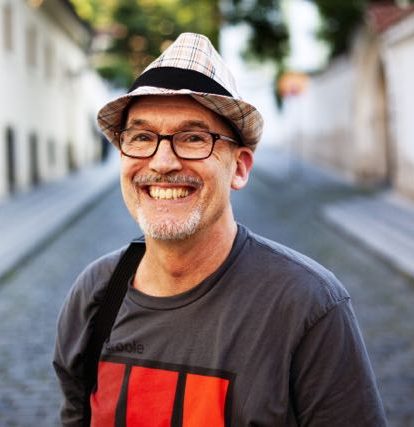
Finish Your Novel with Robert
Robert Eversz (he, him) is the author of eight novels, including Shooting Elvis and Gypsy Hearts from Grove-Atlantic Press, Killing Paparazzi from MacMillan, and Burning Garbo, Digging James Dean, and Zero to the Bone from Simon & Schuster. His novels have been widely translated, with more than two-dozen foreign editions of his work in publication, and have been named to the “best” lists at the Washington Post, Oslo Aftenposten, Manchester Guardian, BookPage, January Magazine, Boston Herald, and The Los Angeles Weekly. The highlight of his many book tours is the time he appeared on the Norwegian equivalent of The Tonight Show with Rukan Elvis, the world’s only Elvis impersonator from north of the Arctic Circle.
A graduate of the UCLA School of Theater, Film, and Television, Robert has been commissioned to write multiple projects for the stage and screen. His radio play, Getting Famous, is currently being broadcast by the German public radio broadcaster, DDR. He has also served as a script consultant, including on Elizabeth Seldes Annacone’s award winning 2024 screenplay, The Great Lillian Hall.
Robert is a founding member of the permanent faculty of the Prague Summer Program, the longest-running study-abroad program for writers in the English language. He has served as the final judge for the Association of Writing Program’s Award Series in the Novel, and has been Visiting Professor and Writer in Residence at Western Michigan University and Hood College.
Robert is most of all proud of the many wonderful and accomplished writers he’s been privileged to mentor, including Natashia Deon, Parnaz Faroutan, Deborah Spera, and Cleyvis Natera.
You can find Robert on the web at:
Author Site: https://robert-eversz.com
Character Site: http://www.ninazero.com/
Facebook: https://www.facebook.com/robert.eversz
Receive Mentorship Today
Apply to join the mentor’s small group of writers that they will lead through our unique mentoring program.
Decide if Robert's Right for You with Our Mentor Interview
Tell us about your current writing life. What are you working on at the moment?
“A few months ago I started to hear the voice of a woman who thinks she’s about to be killed in a shootout with police. The first lines she spoke to me were, I’m writing this on motel stationary, holed up in a room with a half-dead illegal just outside Barstow, the hand that holds the pen spattered with the blood of an ICE agent we left for dead on the streets of Los Angeles. I love unreliable narrators. I’m hoping she’s lying to me, and she isn’t really about to be shot dead. She isn’t exactly telling her story straight so far. That ICE agent wasn’t completely random, or necessarily political. It was personal,” Robert said.
How would you describe your mentoring style?
“Interactive. My task as a mentor is to discover where a writer wants to take a story, and then help them acquire the skills needed to get it there. This involves editing and teaching—I consider editing to be teaching on the page—and above all it needs careful listening to the writer’s voice.”
What first drew you to novel writing — and what keeps you coming back to it?
“My love of reading novels instilled in me the desire to write one. In my mid-teens, a novelist who taught at a local college did not laugh outright at my first attempt to write a novela, and became my first mentor. I’ve been trying to pay it back ever since. My love of the novel was later rivaled by my love of film, and I’ve always considered movies and novels to be close relatives. But I’m always drawn back to the novel because, as John Irving once remarked, when you write a novel, you get to direct. “
What is something you often find yourself saying in feedback to writers?
“E.L. Doctorow once compared writing a novel to driving a car at night. You can only see as far as your headlights, but you can make the whole trip that way. I encourage writers to trust the process, and to trust their subconscious, creative mind to guide them to writing material that’s both surprising and genuine. The act of writing always involves a pas de deux between the writer’s conscious and subconscious minds. It’s important for writers to find their flow state, and use that flow state to connect directly to characters. Because it’s the characters who determine what will happen in a story.”
What kinds of writers or projects are you especially excited to work with right now?
“I’m a believer in the big tent theory of writing. Good writers can work in any or all genres, from the torrid romance novel to mind-bending experimental fiction. Some writers want to pen car chases and gunfights, others sparkling conversation around a dinner table and illicit romances in the kitchen. My task as a mentor is to discover where a writer wants to take a story, and then help them acquire the skills needed to get it there. I love working with writers in all genres, but I’ve read deepest into the mystery and thriller genre, speculative fiction, and historical fiction. “
What is one craft element you think writers often misunderstand or overlook?
“Voice Can’t Be Taught. This pronouncement, often delivered like one of the ten commandments, is a cop out. A mentor should know how to listen, and what to listen for, and then to tell the writer where the voice sounds strong and true. This is much harder than it might appear at first glance. Rather than teaching voice, a teacher helps a writer identify and develop their voice into something uniquely their own. ‘What you’re doing right’ is a more productive approach than ‘What you’re doing wrong.‘ “
Can you share a moment in your own writing career that significantly changed how you approach your work?
“After writing two novels with a conventional male narrator, published by Viking Penguin, I began hearing the voice of a woman convicted of manslaughter speaking from a prison cell. The voice came to me like snippets from a distant radio station that gained in clarity the more I listened. Though I’d been raised hearing women’s voices—the men in my family didn’t talk much—this terrified me. Was it possible for a man to write authentically in the voice of a woman? I wasn’t sure of the answer, but the voice was so compelling that I couldn’t help but listen to it. The voice developed into a novel, Shooting Elvis, that has been translated into more than a dozen languages. This taught me the truth of the Miles Davis quote, “You don’t write what you know. You write what you hear.” “
What does a successful mentorship look like to you by the end of a program like Novel Studio?
“I keep a bookcase in my office stacked with books written by writers I’ve mentored. Some of the novels have been published by one of the Big Five New York houses. Some have been published by small, independent, or hybrid presses. Writers have so many options in this era. One of the many things I love about PocketMFA and the Novel Studio is the program’s focus on avenues of publication as well as literary craft. A successful mentorship looks to me like another book on my bookshelves, and another writer I consider my friend.”
What advice would you give a writer who feels “stuck” in their project right now?
“Stories lose their way most often when the characters themselves are lost, when they can’t quite figure what to do next. So I always go back to character, and the concept of conscious and subconscious objectives. What do the characters want and what will they do to get it? What do the characters fear? The choices that characters make while pursuing their desires and avoiding their fears not only define who they are as characters, they also constitute the basic elements of story. “
What are two recent novels you devoured and would recommend to writers?
“The Grand Paloma Resort, by Cleyvis Natera, is a thrilling summer read with complex characters who stick with you long after you’ve read The End. Creation Lake by Rachel Kushner, because the novel blends genres in a way that seems impossible, but never loses its grip on the story or reader.”